
27. Clarity: The first step toward self-authorship
From Chapter 4: Road to Self-Authorship
For years, my family has held a fall tradition: driving north to the White Mountains in New Hampshire, Vermont, and Maine to chase the autumn foliage. We have fond memories of visiting Franconia Notch, Story Land, and Burlington.
One year, the tradition took a detour. I was in the driver's seat, confidently following the navigation. We had been driving for over an hour, admiring the trees, when I realized something was off. From the backseat, one of my kids piped up: "Dad, did you put it in the right place?" I brushed it off initially, but the question lingered. I pulled over and checked. My heart sank. I had misspelled the town name and selected a destination that was completely irrelevant to our plan. We had been driving enthusiastically in the wrong direction for over an hour. To this day, my kids joke about it: "Dad is taking us on a Pangaea!"
At that moment, I felt a jolt of embarrassment. I felt sorry for wasting my family's time. But I also felt a sudden, sharp spike of motivation to make this right.
Before doing the hard work of discovering our path, most of us need something more basic: the clarity of recognizing that where we are, what we are doing, and how we are behaving is no longer working. It is the stage of acknowledging pain, confronting failure, and for many of us, recognizing the cultural clouds that have obscured our view.
For high-achieving Asian Americans, this stage is particularly difficult because we are masters of endurance. We are taught that if something is hard, we should just work harder. We have to be great at everything. But you cannot author your own life until you admit that the script you have been handed has run out of pages.
Sociologist Jack Mezirow, the father of Transformative Learning Theory, offers an answer that validates this struggle. He argues that adults do not change their fundamental worldview smoothly. We hold onto our ingrained beliefs about how the world works, what success looks like, how we should behave, until they are shattered by what he calls a "Disorienting Dilemma." A crisis that our old self cannot explain or solve. It might be a job loss, a failed promotion, a broken relationship, or a burnout so severe that the usual trick of working harder simply stops working.
For many of us operating to meet others' expectations, this dilemma is not a sign of failure. It is a natural requirement. It forces the question: If I followed all the rules and still ended up here, maybe the rules are wrong.
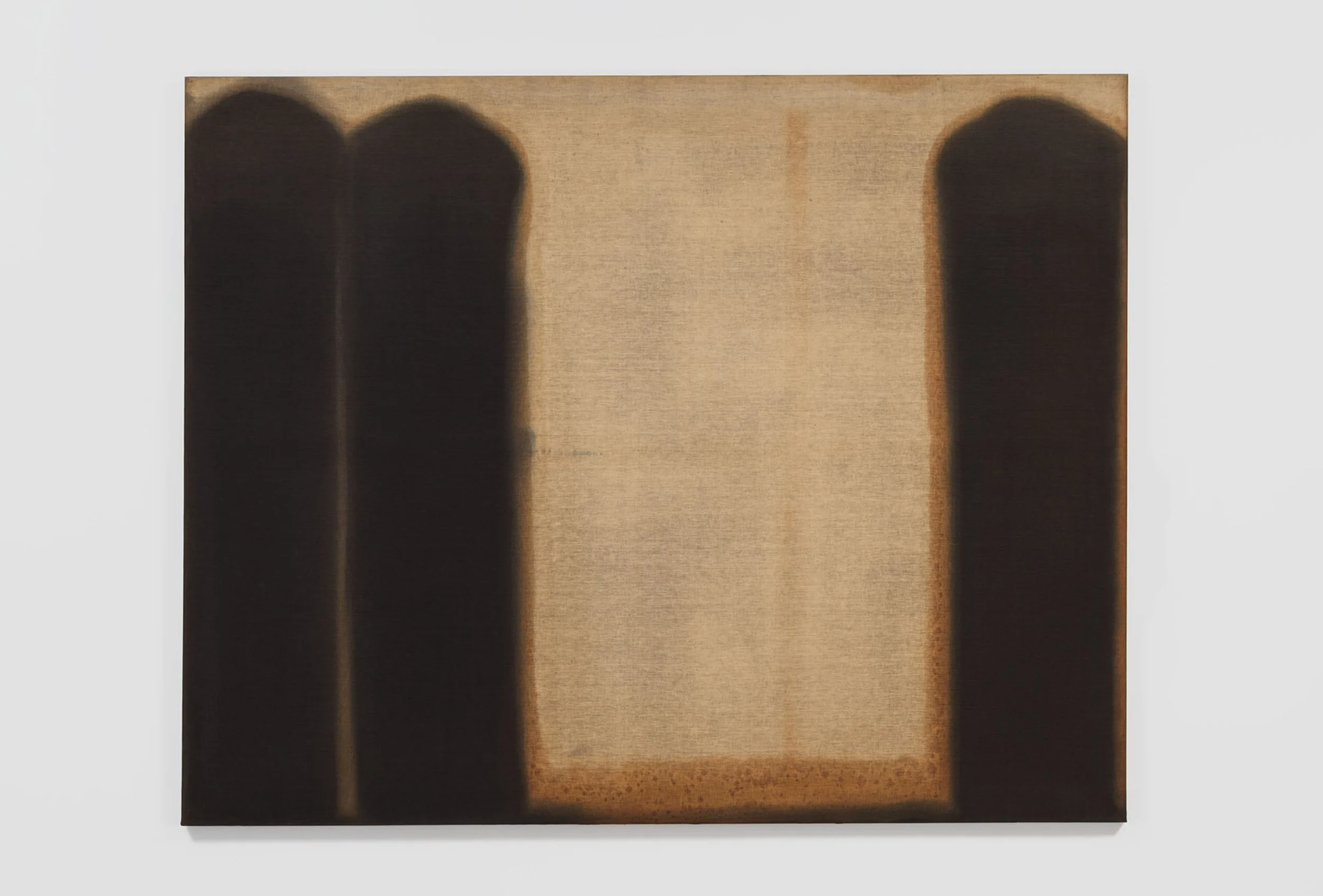
Burnt Umber & Ultramarine, Yun Hyong-keun (https://www.davidzwirner.com)
—————————————————————————————————————————————————————————————————————-
Alice, a second-generation Chinese American in her late twenties, described a moment of clarity that had been waiting years to arrive.
By every measure, she had been a model student: excelling academically, socially easy, someone everyone liked. In her junior year of high school, she enrolled in a full AP course load simply because it was the hardest thing available. "That's what the smart kids did," she told me. When she failed her first AP Chemistry exam with a score of 40 percent, she didn't ask for help. She didn't question whether she was in the right place. Instead, she hid the failure and doubled down, studying past midnight to turn it into a success. "It was incredibly difficult," she said, "to go through that class without being able to tell anyone about it, while pretending to my peers that it was perfectly manageable."
Now a manager in process innovation consulting, Alice recognized through our work together that history was repeating itself. She was grinding through work she felt naturally unsuited for, still following the same script. "I grew up with the belief that I had to excel at everything I touched," she said, "and that weaknesses should be hidden." She could still hear her parents' voices: That's not good enough. Work harder. You should be like our friend's kid, Steven.
I asked her to do something uncomfortable: to go home and have a real conversation with each of her parents. Not about her career, but about theirs. About their upbringing, their ambitions, what it cost them to immigrate, what they were afraid of, what they were proud of.
She was resistant at first. The dinner table had always been a place to be on guard, ready to defend a bad grade or manage a difficult announcement. But she took the challenge.
After two separate conversations, she came back changed. "I understand them better now," she said, "as people shaped by their own histories and fears." When her father tells her to climb the corporate ladder, she no longer hears it as a command. She hears the story underneath it: his own unlived ambitions, his fear for her, his particular way of showing love. "That understanding has taken away some of the emotional charge," she said. "Instead of immediately reacting, I'm starting to see where they're coming from. Even when I don't agree."
For Alice and for me, the path to self-authorship began with the courage for clarity: the willingness to face our reality exactly as it was, even when the truth was uncomfortable. We had to recognize that the rules we were following were not our own, and that the very habits of grit and perfection that once carried us forward had become our blind spots.
But clarity is only the first step. Once we find the courage to see our Pangaea for what it is, driving enthusiastically in the wrong direction, the sting of embarrassment turns into a sharp spike of motivation. We are no longer content being passengers in someone else's script. With the engine light identified, we can begin the real work: digging through the layers of expectation to find the internal compass that will guide our next drive.