

Friendship through tasting new wines
Hi, All,
Before you head off to your next chapter, I'd love one more chance to be together, outside the coaching environment, just enjoying good company.
MIT has been a special place for me, and getting to work with each of you made it even more so.
Wine is one of my ongoing areas of curiosity. It feeds the same learning instinct I try to bring to everything. So I thought: why not let the wines reflect some of you?
We'll be tasting 8 wines — 4 whites and 4 reds — from Chile, Greece, Lebanon, and Spain. These are regions most wine drinkers underestimate, or never quite get around to exploring. The full lineup is below. Come in curious.
The wines will be poured blind and numbered. You'll try to guess which one is which. We'll taste together, compare notes, and I'll do the reveal at the end.
Joonki
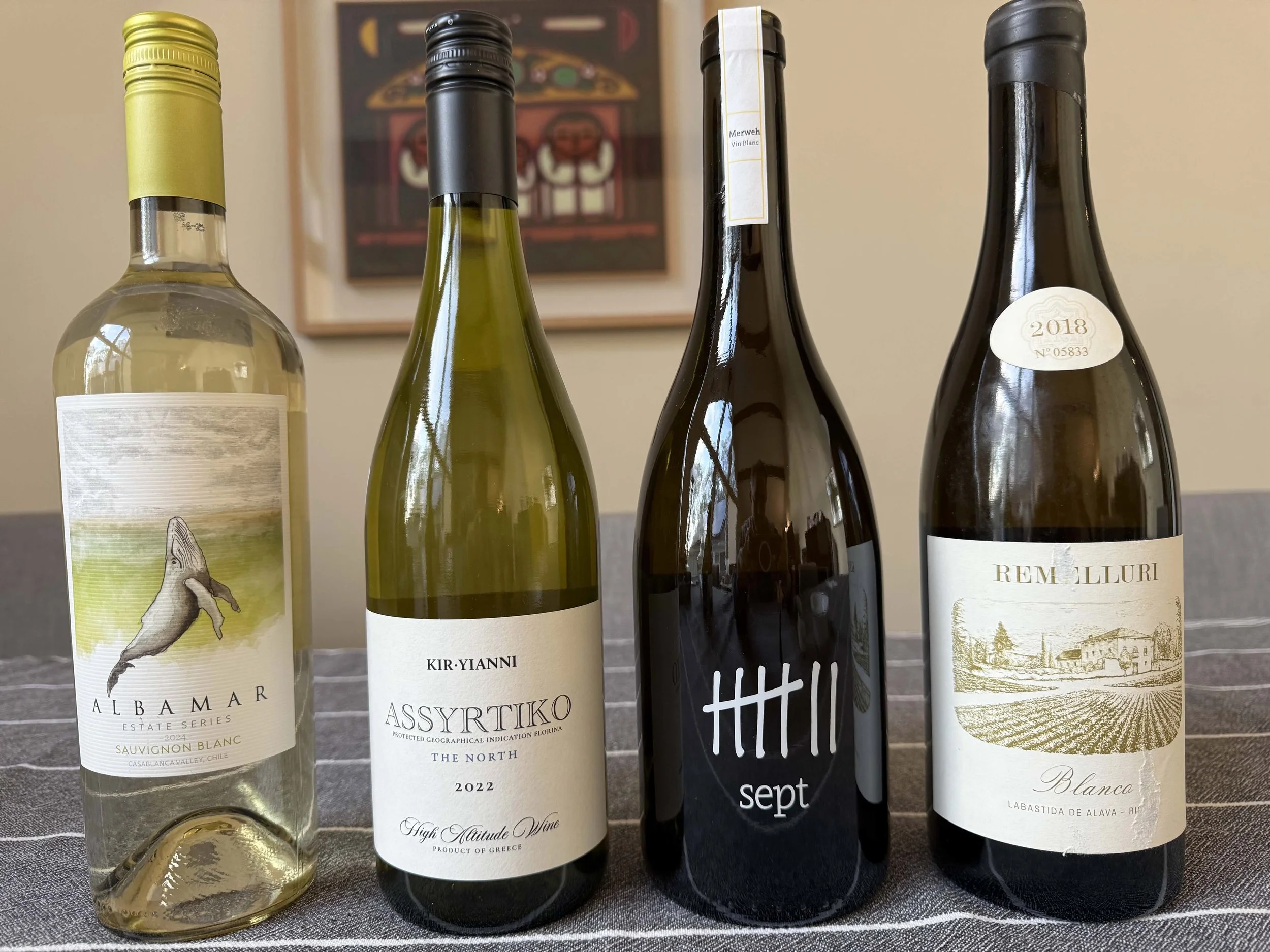
Whites
2024 Albamar Sauvignon Blanc
From where: Chile, Casablanca Valley (cool-climate coastal region)
Varietal: Sauvignon Blanc
Albamar is the entry-tier label of William Cole Vineyards, made to capture the bright, herbaceous personality of Casablanca's Pacific-cooled vineyards. James Suckling rated the 2024 vintage 87 points, describing "a simple grassy nose, showing asparagus, fresh guava and passion fruit" and a wine that is "generous and easy on the palate with generous fruit and a short finish — drink now." Crisp, bone-dry, and very food-friendly, it's the kind of midweek white that flatters goat cheese salads, ceviche, or a plate of grilled white fish with lime. (Source: James Suckling / Wine Enthusiast)
2022 Kir-Yianni Assyrtiko Le Nord
From where: Greece, Macedonia, Florina
Varietal: Assyrtiko
The Assyrtiko grape burst onto the modern wine scene with vividly crisp and intense dry whites from the Aegean island of Santorini. So good, so scarce, and now so expensive, growers quickly planted Assyrtiko all over the mainland and now there are better values and almost as good Assyrtiko from all over Greece. Kir-Yianni's version from Naoussa in 'The North' is planted at a high elevation and yields crisp, deep flavors. Try this full-flavored white with a lemony chicken dish surrounded by briny olives. (Source: The Wine and Cheese Cask)
2023 Sept Winery Merweh
From where: Lebanon, Mount Batroun, overlooking the Mediterranean
Varietal: Merweh (an indigenous Lebanese white grape)
Sept is Lebanon's first and only biodynamic winery, founded by self-taught winemaker Maher Harb, who tracked down a century-old, ungrafted Merweh vineyard that survived phylloxera, civil war, and decades of abandonment. The wines are made with native yeasts, spontaneous fermentation, no additives beyond a tiny dose of sulfur, stainless steel only, and aging on lees with some skin contact. Reviewers of recent vintages note a brilliant golden color, white-flower and stone-fruit aromas, citrus and tropical notes, lively acidity, and a slightly saline finish. A great pairing with grilled sea bass, mezze with labneh and za'atar, or a lemony roast chicken. (Source: 209 Lebanese Wine / Pleasure Wine producer notes)
2018 La Granja Nuestra Señora de Remelluri Rioja Blanco
From where: Spain, Rioja Alavesa, Labastida (single-estate vineyard at the foot of the Sierra de Toloño)
Varietal: A traditional Mediterranean white field blend — predominantly Garnacha Blanca and Viognier, with smaller proportions of Roussanne, Marsanne, Chardonnay, Sauvignon Blanc, and Moscatel, all from organically farmed estate vines
Remelluri's white is one of Rioja's most distinctive whites, made by Telmo Rodríguez from a single mountainside estate rather than the usual blended-fruit approach. James Suckling called it "a fantastic white with tightness and freshness and such bright acidity," noting "sliced apple, pear, pineapple and lilac. Full-bodied yet tight and so fresh, goes on for minutes" — "precise and transparent," with "great length." Tasters often compare its chalky minerality to a fine Chablis. Lovely with roasted poultry, seafood paella, or aged Manchego. (Source: James Suckling / CellarTracker)
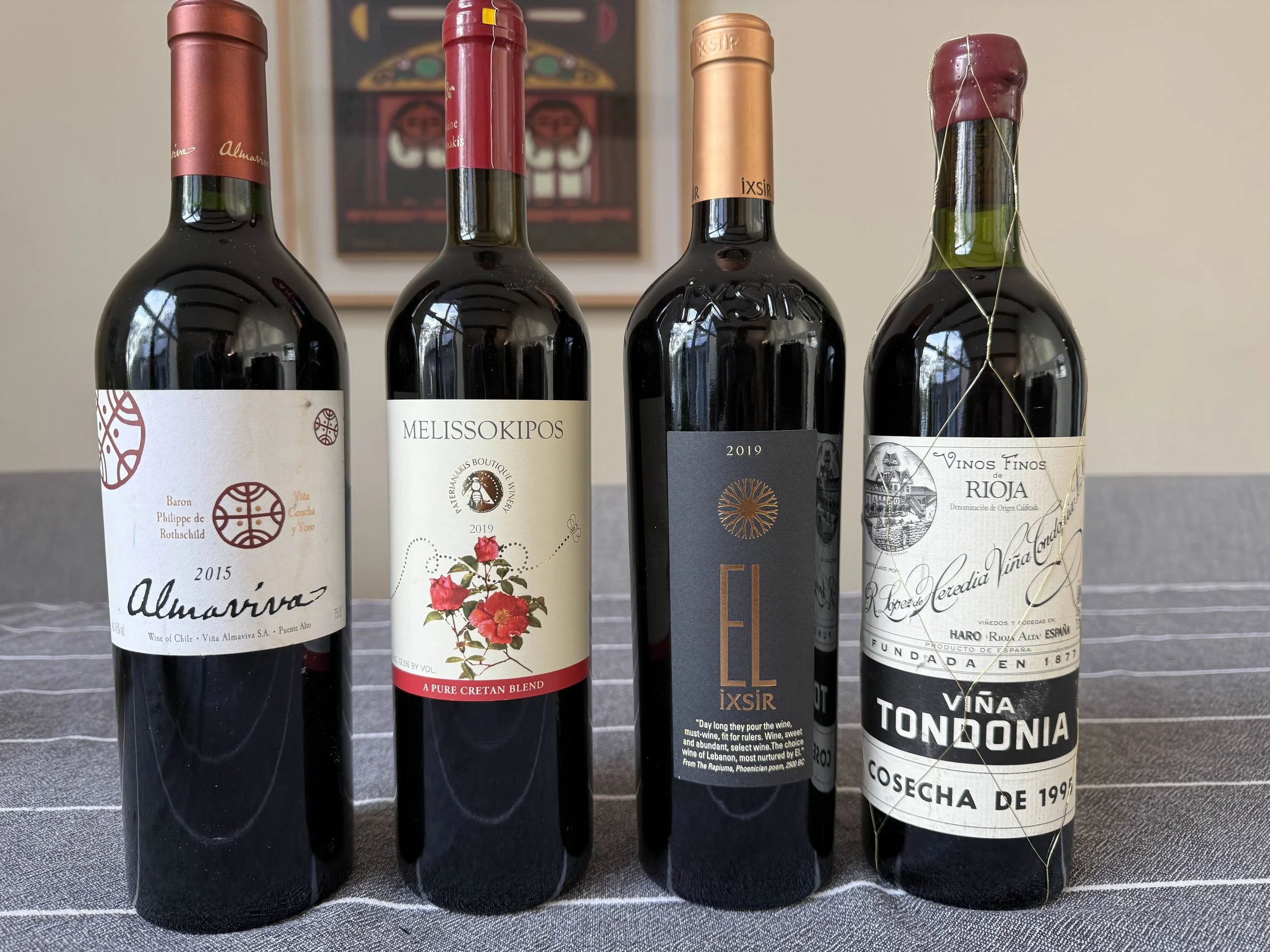
Reds
2015 Almaviva
From where: Chile, Maipo Valley, Puente Alto
Varietal: 69% Cabernet Sauvignon, 24% Carmenère, 5% Cabernet Franc, 2% Petit Verdot
Almaviva is the storied joint venture between Bordeaux's Baron Philippe de Rothschild and Chile's Concha y Toro, and Puente Alto's gravelly, alluvial soils have made it one of South America's most acclaimed Bordeaux-style blends. The 2015 vintage earned a perfect 100 points from James Suckling and was named his #1 Wine of 2017. Suckling's note describes "a glorious and complex nose of tobacco, blackberries and hints of stones and flowers," a full body with a linear backbone, and a creamy, polished texture on very round tannins. A celebration bottle — open it with dry-aged ribeye, slow-braised short rib, or aged hard cheeses. (Source: James Suckling / International Wine Report)
2019 Domaine Paterianakis Melissokipos
From where: Greece, Crete, Melesses (south of Heraklion)
Varietal: Kotsifali and Mandilari (two indigenous Cretan red grapes)
The wines of Crete are seeing a resurgence as winemakers update traditional techniques on native grapes cultivated throughout their island's 4,000 year winemaking history. The Paterianakis family is at the forefront of this momentum, having restored indigenous varieties and instituted organic practices in the late 1980s. As the third generation of their family in the business, sisters Emmanuela and Niki continue to innovate and showcase unique wines from the land surrounding their village of Melesses, located south of Crete's capital city Heraklion. Their Melissokipos, meaning 'Garden of the Bees,' is an homage to the bee-keeping industry that gave their village its name during the second Byzantine empire. It's a refreshing and umami-laden blend of two indigenous red grapes, Kotsifali and Mandilari, with scents of cinnamon, tomato leaf, and cedar. Perfect for a lamb braised with tomatoes. (Source: The Wine and Cheese Cask)
2019 Ixsir El
From where: Lebanon, Batroun (sourcing from high-altitude sites averaging over 1,000 meters across northern Lebanon and the Bekaa Valley)
Varietal: Cabernet Sauvignon, Syrah, and Merlot blend
The vision behind IXSIR is to reveal the best terroirs of Lebanon, some long since forgotten. Cultivated with respect to sustainable agriculture, IXSIR’s vineyards are spread across the mountains of Lebanon on clay-calcareous and limestone soil, from Batroun to Jezzine, benefiting from microclimates that are unique to Lebanon. IXSIR’s vineyards culminate at an altitude of 1,800 metres, making them the highest in the Northern Hemisphere. The 2019 vintage hows, on the palate, notes of blackcurrant mingle with a subtle hint of infusion, followed by a whisper of cedar. The vintage proves intriguing and round, offering a harmonious complexity evolving with elegance. Flavours of blackcurrant and spices linger on the palate, giving way to the expression of the terroir that has shaped these delightful nuances. (Source: producer’s website
1995 R. López de Heredia Rioja Gran Reserva Viña Tondonia
From where: Spain, Rioja Alta, Haro (estate-bottled from the legendary Viña Tondonia vineyard along the Ebro)
Varietal: Tempranillo (~75%), Garnacha (~15%), Graciano (~5%), Mazuelo / Carignan (~5%) — the classic Tondonia blend
A bottle from one of Rioja's most uncompromising traditionalists, López de Heredia ages its Gran Reservas a decade or more in old American oak before release, and the 1995 came from a vintage rated "Excelente" in Rioja after years of drought. A vibrant red with amber edges leading to "dried blood orange peel, white pepper, dried thyme, iron, berries, minerals, black sesame seeds and old books," with firm tannins, a full body, and an "extremely bright, lengthy finish." This is a meditative, mature Rioja — pair with roast lamb, jamón ibérico, mushroom risotto, or simply sit with it and a wedge of aged cheese. (Source: Wine.com / CellarTracker community notes)